DARPA’s July 2026 VENOM announcement described a shift from a unique experimental aircraft toward modified F-16 test platforms for AI development. That is a useful way to judge autonomy’s strategic importance: the advance is not only a more capable algorithm, but an infrastructure for testing and improving multiple algorithms on real aircraft. DARPA July 2026 VENOM flight tests
Move beyond the prototype count
Our analysis uses three questions: can the capability be repeated, can it be sustained, and can the institution learn? A one-time demonstration may answer part of the first. Operational organizations still need training, maintenance and a way to incorporate lessons without making the system less reliable or less accountable.
Scale should also be defined carefully. More machines can create more coverage, but can also increase the burden of support and coordination. The strategic outcome depends on the task and the surrounding organization. A headline count cannot substitute for evidence about availability, effectiveness and the resources required to keep systems useful.
Look for durable options
The most meaningful change may be a broader set of choices. A country able to adapt systems locally may respond more flexibly to new needs. An alliance able to share learning may avoid duplicating every experiment. These are plausible mechanisms of advantage, not automatic consequences of acquiring autonomous technology.
The evidence to watch is therefore institutional: repeatable exercises, accepted systems, qualified personnel, update processes and continuing support. Autonomy may alter national power through those accumulations rather than a single dramatic product launch. Careful reporting recognizes technical progress while resisting the temptation to turn a narrow demonstration into a prediction about conflict outcomes, strategic dominance or inevitable political change.
A repeatable test system can matter more than one result
The VENOM Autonomy Kit connects with the aircraft’s flight controls and mission systems, allowing experimental AI operation while a pilot retains a switch back to human control. DARPA says the platforms will support its Artificial Intelligence Reinforcements program and increasingly complex multi-aircraft testing. These are development capabilities and plans, not a declaration of an operational autonomous fighter fleet. DARPA July 2026 VENOM flight tests
Our assessment is that repeatability is the strategic feature. A one-off demonstration can establish that something is possible. A reusable test environment can help an institution compare approaches, identify failures and improve the next version. That creates a process for accumulating capability rather than depending on a single successful event.
Britain is building another kind of learning system
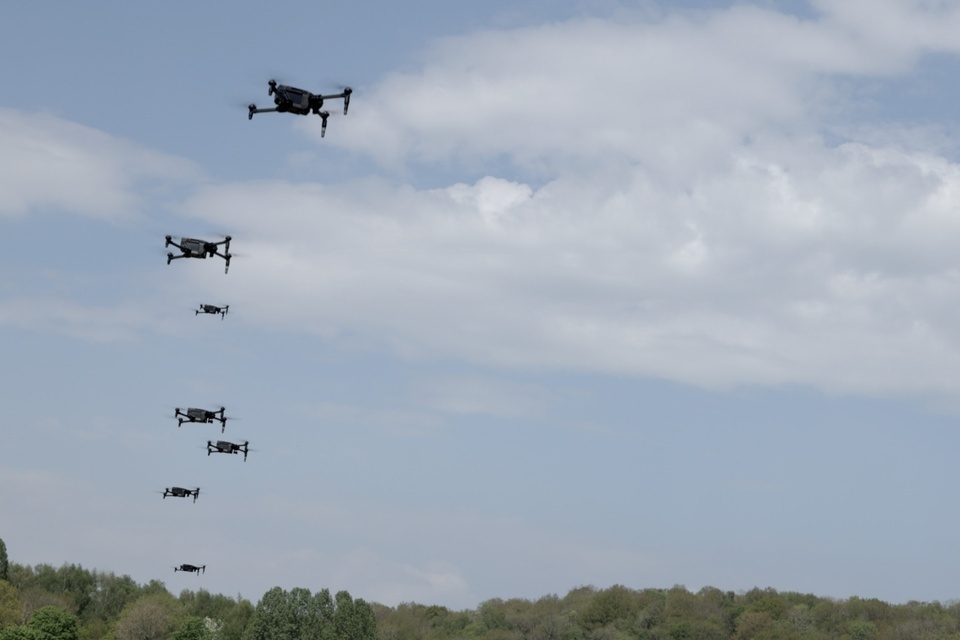
Dstl’s September 2026 swarm account described an eight-aircraft test bed placed with Army operators after trials involving two competing industry options. Further experimentation was planned into 2027. This is a smaller and different platform set, but the organizational pattern is comparable: operational users gain a place to explore behavior and requirements. Dstl September 2026 swarm experiment
The comparison does not establish that either country leads in all autonomy. Aircraft type, mission, constraints and test conditions differ. It shows instead that national capability includes the ability to run repeated learning cycles. A country with a dramatic demonstration but no durable evaluation organization may struggle to turn technical possibility into dependable practice.
Data partnerships can change the learning rate
The UK’s late-September Ukraine AI competition adds access to operationally collected imagery and a defined industrial selection process. Earlier, the September 2025 technology-sharing agreement identified Project OCTOPUS as an initial joint manufacturing and development effort. The two initiatives address different inputs: data for models and designs for physical production. UK September 2026 Ukraine AI-data competition UK–Ukraine September 2025 technology-sharing agreement
These relationships can be strategically consequential without a merger or a giant procurement total. They may connect practical experience to engineering teams and manufacturing capacity. Their actual effect still depends on execution: how quickly useful data reaches developers, how well designs transfer, and whether the resulting products meet operational needs at sustainable cost.
Taiwan shows why scale must remain separate
Shield AI’s NCSIST release reported a three-aircraft search demonstration and expanded cooperation. That is a tangible milestone in local integration, but the public result is not a measure of an entire national force. It does not disclose every operating condition, fleet readiness rate or supporting supply requirement. Shield AI NCSIST exercise, August 2026
The comparison with VENOM and the British test bed highlights a common reporting mistake. Counting platforms at a demonstration treats the visible machines as the whole capability. In practice, local engineers, test methods, support organizations and authority to modify software may determine how far the result can spread.
A better measure of national power
Autonomy changes national power when it alters what an organization can reliably accomplish, how quickly it can adapt and what resources it needs. Those effects can include broader sensing, reduced operator burden or faster development. They must be demonstrated in context, not presumed from the word autonomous.
A useful public assessment therefore follows several connected records: technical performance, repeated testing, industrial delivery, operator training and sustained availability. None alone is enough. The 2026 examples show institutions investing in the machinery of learning as well as in the machines themselves. Whether that becomes a durable strategic advantage will depend on their ability to convert those learning cycles into responsible, repeatable operations.
Sources & evidence
This archive preserves its original editorial date. Sources describe the events and announcements discussed; they do not establish today’s status.